Description
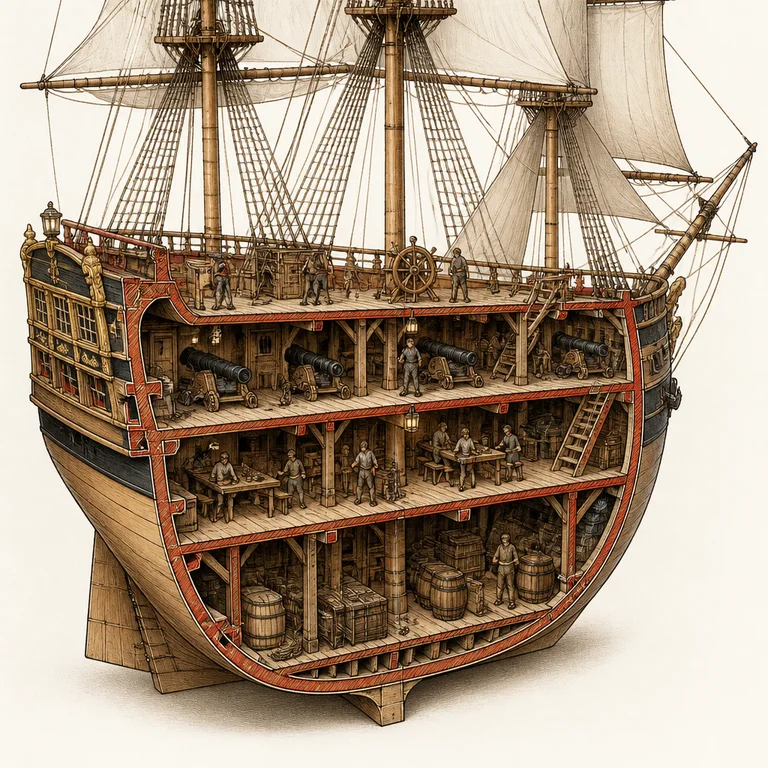
Technical cutaway illustration is the explanatory picture that slices a building, machine, or body open so you can see how it works — the visual language of how-things-work books, infographics, and exploded-diagram engineering art. It is a precision craft built to teach, and it has a grammar distinct from both blueprint drafting and decorative illustration. Visual rules: a clear hero subject with one side, wall, or skin peeled or sliced away to reveal interior systems, drawn so the cut edge reads cleanly (often hatched or stepped); accurate spatial logic — everything stays in correct perspective and scale even when impossibly transparent; consistent line weight hierarchy, with structural lines heavier than detail lines; selective rendering — important systems coloured or shaded, surrounding context kept lighter so the eye knows where to look; small human or object figures for scale and storytelling; clean, even, diagrammatic light with no theatrical shadow; optional callouts, arrows, and labels integrated into the composition. Fritz Kahn's strand adds metaphor — the body drawn as a literal factory of workers and machinery. Use it for explainers, engineering and product visuals, museum interpretation, educational publishing, and any image that must make a complex system legible. It does not do mood, atmosphere, or ambiguity — clarity overrides beauty and nothing is left to interpretation. Models produce generic "blueprint." Specify "technical cutaway illustration, one side sliced away with a clean hatched cut edge, accurate perspective, line-weight hierarchy, selective colour on key systems, tiny figures for scale, even diagrammatic light, Biesty or Macaulay style."
Three pioneers
Every style in this catalog names three verifiable pioneers. This is the part of the drop test that takes the longest to write and is the easiest to spot when it's missing.
-
Stephen Biesty
British illustrator, born 1961. His Incredible Cross-Sections series (from 1992, with Dorling Kindersley) — a Man-of-War, a castle, the Empire State Building rendered as densely populated cutaways — is the defining modern reference for the narrative cutaway.
-
David Macaulay
British-American illustrator, born 1946. Cathedral (1973) and The Way Things Work (1988) built the explanatory-illustration canon — pen-and-ink construction and machinery cutaways with a teaching narrative; The Way Things Work has sold millions across editions.
-
Fritz Kahn
German physician and illustrator, 1888–1968. Der Mensch als Industriepalast (Man as Industrial Palace, 1926) drew the human body as a literal factory staffed by tiny workers — the founding work of conceptual infographic and the metaphor-cutaway tradition.
Contemporary revival
The explainer-and-infographic publishing boom, Taschen's Fritz Kahn monograph, and David Macaulay's continued print and broadcast presence
Taschen published the definitive Fritz Kahn monograph (Uta and Thilo von Debschitz, 2013) which put Man as Industrial Palace back into wide circulation and into design-school curricula as the origin point of modern infographic; the von Debschitz Fritz Kahn project and travelling exhibitions followed. The explainer-infographic format is a documented growth category — the success of titles like Macaulay's reissued The Way Things Work Now (2016) and the broader 'how it works' shelf, plus animated-explainer studios and the data-visualisation field, all explicitly cite Kahn and Macaulay as lineage. Macaulay's PBS specials (Roman City, Cathedral, Pyramid) remain in educational distribution, and Stephen Biesty's cross-sections are perennially reissued by DK. Cutaway and exploded-view illustration is a standing, searched commercial brief for product, museum, and editorial work.
Working prompts
Three prompts we've tested against current FairStack models. Copy and run.
-
Technical cutaway illustration of a multi-deck wooden sailing warship with one hull side sliced away, clean hatched cut edge, accurate perspective and scale, line-weight hierarchy with heavier structural lines, tiny crew figures at work on every deck for scale and story, even diagrammatic light, Stephen Biesty style
-
Macaulay-style pen-and-ink cutaway of a Gothic cathedral under construction, scaffolding and stonework systems revealed, selective shading on the key structure, teaching-narrative clarity
-
Fritz Kahn conceptual cutaway, the human torso drawn as an industrial palace with tiny workers operating machinery in each organ, 1920s diagram styling, metaphor-as-explanation
Recommended models
Models from FairStack's catalog that handle this style best. Sorted by price.
Related styles

New Yorker Editorial Ink
The New Yorker has run editorial illustration and cartoons in a coherent visual language for nearly a century. The style is not one artis…
Open style
Botanical Scientific Illustration
Botanical scientific illustration is the four-century discipline of rendering a plant accurately enough to identify the species while mak…
Open style
Saul Bass Title Card
Saul Bass (1920–1996) redefined what film title sequences could be — he made them part of the film, not a list of names to skip — and the…
Open style
Mid-Century Graphic Illustration
Mid-Century Graphic Illustration is the flat, witty, geometry-driven American commercial illustration of roughly 1948–1965 — the look of…
Open style