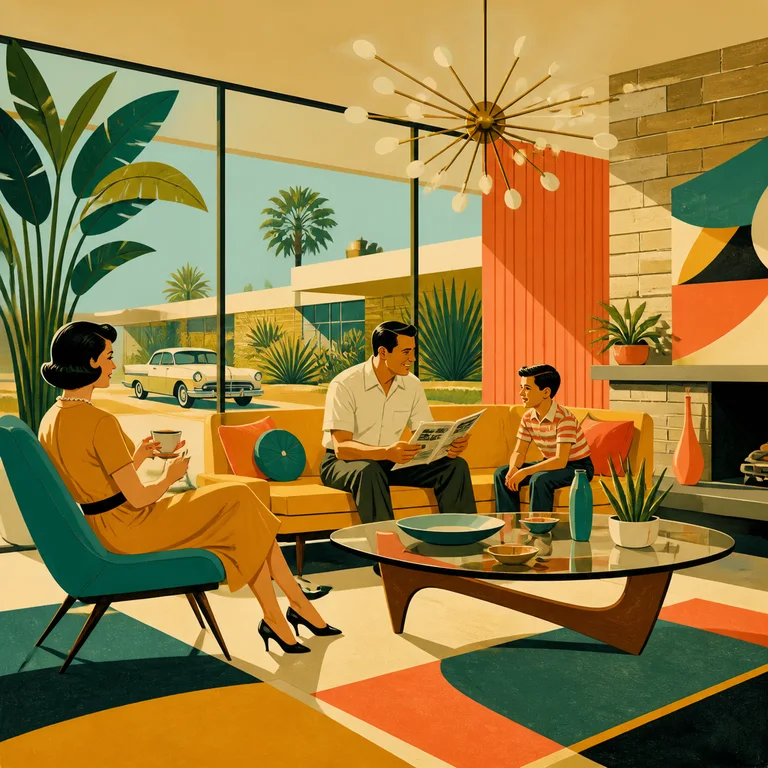
Description
Mid-century modern is the visual language of postwar American optimism, roughly 1947 to 1965, born in California, Scandinavia, and Italy and disseminated by Eames-era furniture, Look and Life magazine layouts, Charley Harper's wildlife illustration, the Provensens' children's books, and Saul Bass's title sequences. Mary Blair sits in the same family but earns her own entry — Blair is the children's book / theme-park branch of a much larger tree. The grammar: flat, opaque shapes built from gouache or screen ink; warm but slightly muted palette (mustard, teal, coral, brick, walnut brown, cream); geometric reduction with no rendering of volume except through shape silhouettes; abstract organic-meets-geometric forms (the boomerang, the amoeba, the starburst); Helvetica-era sans-serif typography with generous spacing; suburban-and-atomic-age subject matter — ranch houses, sputnik chandeliers, two-tone sedans, smiling families, atomic motifs. Use it for retro advertising, 1950s and early-60s period work, children's editorial, interior design references, mid-century furniture catalogs, and friendly-corporate illustration. It does not do edgy, gritty, or contemporary. Models will give generic "vintage" if asked vaguely — specify "1950s mid-century modern, flat gouache shapes, mustard-teal-coral palette, boomerang and starburst motifs, geometric organic forms."
Three pioneers
Every style in this catalog names three verifiable pioneers. This is the part of the drop test that takes the longest to write and is the easiest to spot when it's missing.
-
Charles and Ray Eames
American husband-wife design partnership. Eames Lounge Chair (1956), the molded plywood chairs, and their films (Powers of Ten, 1977) defined mid-century modern's three-dimensional vocabulary — bent plywood, fiberglass, plastic-and-wire.
-
Charley Harper
American illustrator, 1922–2007. His 'minimal realism' wildlife illustrations — Ford Times magazine covers (1950s–60s), Golden Book of Biology (1961) — are the canonical flat-geometric-organism style.
-
Alvin Lustig
American graphic designer, 1915–1955. New Directions paperback covers (late 1940s) and Reporter magazine work introduced flat-geometric-modernist illustration into American mass print before his early death.
Contemporary revival
Mad Men (AMC, 2007–2015) and the persistent Pinterest / Apartment Therapy / Design Within Reach mid-century furniture market
Mad Men's 92-episode run drove a sustained mid-century revival in furniture, fashion, and visual references that is still measurable in design press a decade after the finale. Eames Lounge Chair production at Herman Miller exceeds 10K units per year at $7K+. #midcenturymodern on Instagram exceeds 8M posts. Charley Harper's estate and merchandise sales (puzzles, prints, fabrics) reach 7-figure annual revenue. The aesthetic remains the default 'optimistic retro' look in advertising — every Squarespace and Mailchimp campaign borrows from it.
Working prompts
Three prompts we've tested against current FairStack models. Copy and run.
-
1950s mid-century modern illustration, flat gouache magazine spread of suburban family in ranch house, mustard teal coral palette, boomerang coffee table, sputnik chandelier, geometric-organic plants, Helvetica caption
-
Charley Harper style minimal realism, geometric flat illustration of cardinal on dogwood branch, warm muted palette, abstract reduction to circles and triangles, no rendering of volume
-
mid-century modern advertising layout, smiling 1950s family around a two-tone sedan, flat shapes, atomic-age starburst motif, mustard-and-walnut color scheme, sans-serif headline
Recommended models
Models from FairStack's catalog that handle this style best. Sorted by price.
Related styles
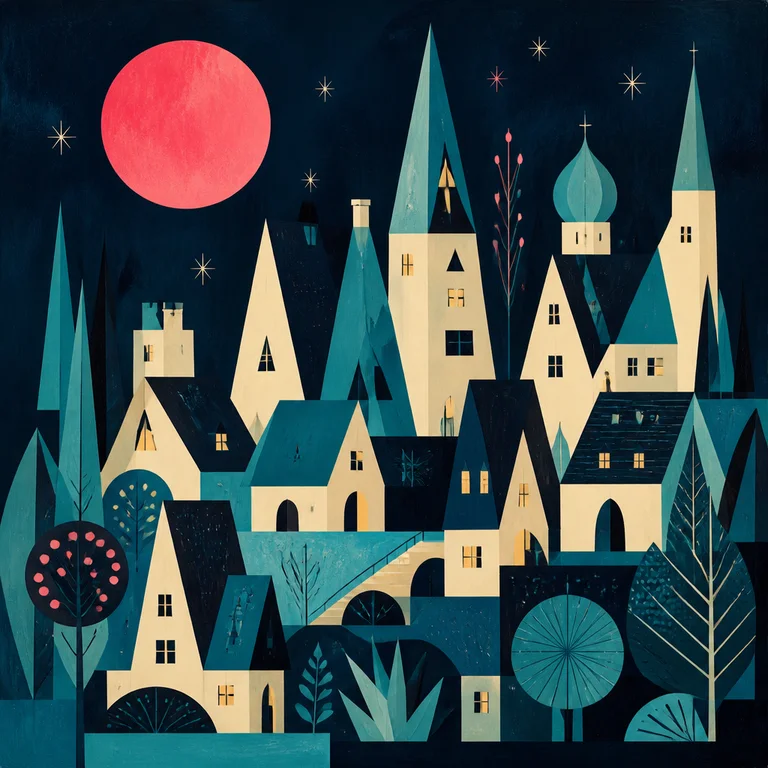
Mary Blair Mid-Century
Mary Blair's concept art for Disney between 1940 and 1965 — Cinderella, Alice in Wonderland, Peter Pan, and the It's a Small World ride —…
Open style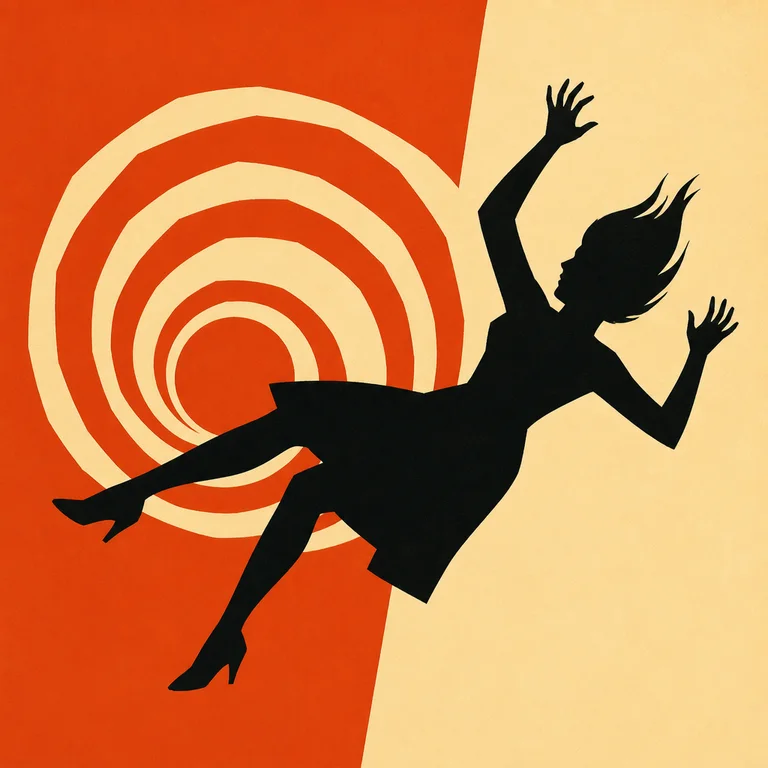
Saul Bass Title Card
Saul Bass (1920–1996) redefined what film title sequences could be — he made them part of the film, not a list of names to skip — and the…
Open style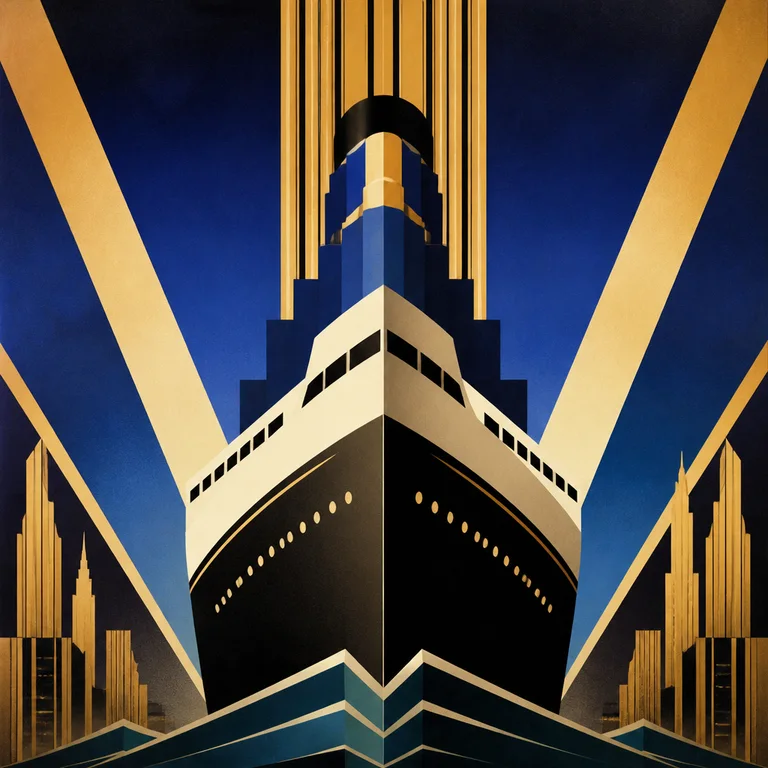
1920s Art Deco
Art Deco was the dominant decorative style from roughly 1920 to 1939, born at the 1925 Paris Exposition Internationale des Arts Décoratif…
Open style
WPA Travel Poster
Between 1936 and 1943 the Works Progress Administration's Federal Art Project produced over 2,000 silkscreened posters to promote nationa…
Open style