Description
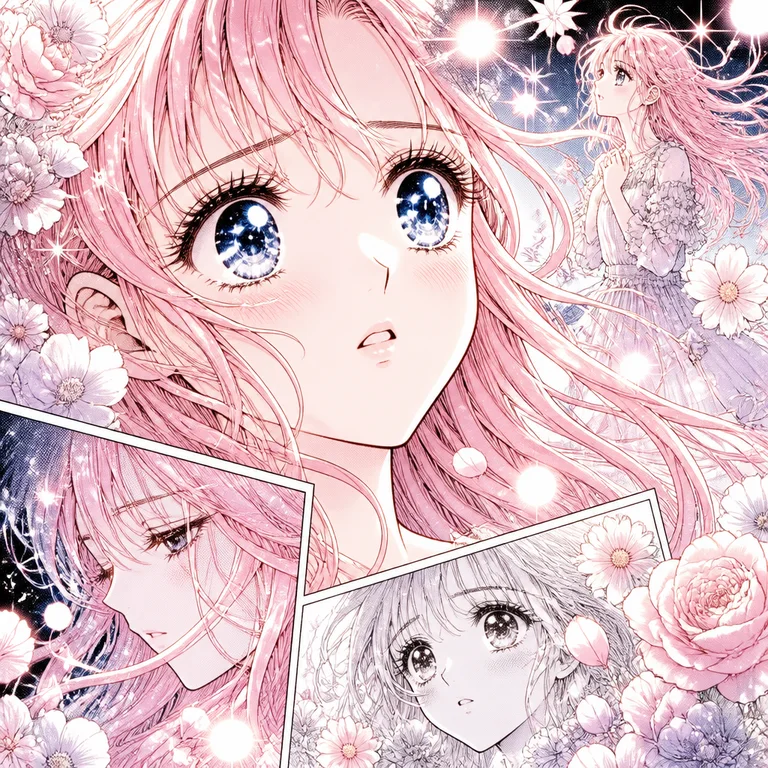
Shōjo ("young woman") manga is the Japanese comics category aimed at teenage girls. The category formed around magazines like Nakayoshi (1955), Ribon (1955), and Margaret (1963), and the visual language was set by a cohort of female artists in the early 1970s — Moto Hagio, Keiko Takemiya, Ryoko Yamagishi, and others known as the Year 24 Group (Showa 24, 1949 — the year most of them were born). Their formal innovations remain the dominant grammar of shōjo today. Visual rules: enormous, often star-spangled eyes that take up most of the face's vertical space; pages broken into overlapping non-rectangular panels with characters bleeding across panel borders; flowers, sparkles, and decorative screentone patterns flowing through backgrounds, often replacing literal setting at moments of high emotion; tall, slim, androgynous figures with elaborate flowing hair; internal monologue rendered as borderless floating text within the panel composition; muted screentone shading rather than the heavy black inks of seinen or shōnen; emotional and romantic subjects — friendship, first love, families, identity, occasionally fantastical and supernatural plots. Use it for romance and slice-of-life illustration, character portraits with emotional emphasis, fashion and editorial illustration with manga lineage, contemporary "girls' comic" book covers, and any image where decorative emotional weight should dominate over literal setting. Models will produce generic "anime girl." Specify "shōjo manga aesthetic, Year 24 Group lineage or modern Margaret magazine style, enormous star-spangled eyes filling face, overlapping non-rectangular panels with figures bleeding across borders, flowers and sparkles flowing through background at emotional peak, tall slim androgynous figures with elaborate flowing hair, screentone shading."
Three pioneers
Every style in this catalog names three verifiable pioneers. This is the part of the drop test that takes the longest to write and is the easiest to spot when it's missing.
-
Moto Hagio
Japanese mangaka, born 1949. Founding Year 24 Group member. The Heart of Thomas (1974), The Poe Clan (1972–76) introduced psychological depth, gender ambiguity, and decorative panel composition to mainstream shōjo. Eisner Hall of Fame, 2022.
-
Keiko Takemiya
Japanese mangaka, born 1950. Year 24 Group. Kaze to Ki no Uta (The Song of Wind and Trees, 1976) was the first major shōjo work to use overlapping panels, fluid page layouts, and unflinching emotional content as standard. Now an educator at Kyoto Seika University.
-
Naoko Takeuchi
Japanese mangaka, born 1967. Sailor Moon (1991–1997) globalized the shōjo visual vocabulary — the eyes, the sparkles, the transformations, the magical-girl format. Over 35M copies in print; the anime aired in 50+ countries.
Contemporary revival
The continuing global Sailor Moon franchise revivals (Sailor Moon Crystal, Cosmos, 2014–24), the steady commercial dominance of shōjo isekai (Reincarnated as a Villainess and similar), and a Western webcomic and Instagram-illustration scene that operates entirely in shōjo grammar
Sailor Moon merchandise sales exceeded $13B cumulative as of 2024 per Toei reporting. Sailor Moon Cosmos films released 2023 globally and remain in the Crunchyroll top tier. Shōjo-derived isekai series — My Next Life as a Villainess, Bibliophile Princess — have been some of the highest-streamed seasonal anime on Crunchyroll and HiDive between 2020 and 2025. The Magnolia / Asuka generation of contemporary shōjo titles (Skip and Loafer, A Sign of Affection 2024) is critically and commercially successful. #shojomanga on Instagram exceeds 1M posts; #magicalgirl exceeds 4M. The Western 'pastel anime' Instagram aesthetic is shōjo grammar adapted to non-manga output. Viz Media's shōjo catalog has tripled in size since 2018.
Working prompts
Three prompts we've tested against current FairStack models. Copy and run.
-
shōjo manga page composition, tall slim teenage girl with enormous star-spangled blue eyes filling the panel, elaborate flowing pink hair, overlapping non-rectangular panels with her figure bleeding across borders, flowers and sparkles flowing through background at the moment of emotional realization, screentone shading, internal monologue as borderless floating text, Year 24 Group lineage
-
Sailor Moon-style shōjo character portrait, magical-girl transformation sparkles surrounding figure, oversized expressive eyes, decorative ribbon and flower motifs across background, restrained pastel-and-jewel palette
-
modern shōjo cover illustration, first-love scene with two slim figures under cherry blossoms, sparkle effects, sparkly large eyes, decorative pattern integrated into the background, manga-magazine aesthetic
Recommended models
Models from FairStack's catalog that handle this style best. Sorted by price.
Related styles

Modern Webtoon
Webtoon is the Korean-originated vertical-scroll digital comic format that has, since roughly 2015, become the dominant comics format glo…
Open style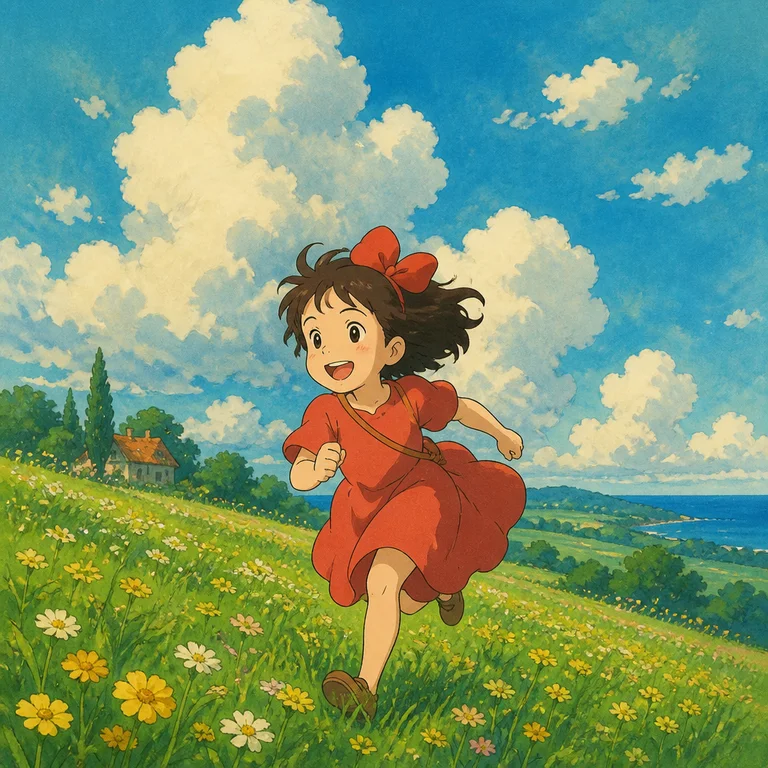
Studio Ghibli
Studio Ghibli's films share a visual identity that has held remarkably steady from Castle in the Sky (1986) through The Boy and the Heron…
Open style
Kyoto Animation Soft
Kyoto Animation (Kyoani, founded 1981) is the studio whose mature TV work — K-On! (2009), Hyouka (2012), Sound! Euphonium (2015–24), Viol…
Open style
Chibi / Super-Deformed
Chibi (literally "short" in Japanese) and its near-synonym SD ("super-deformed") describe a stylistic mode where characters from a host a…
Open style