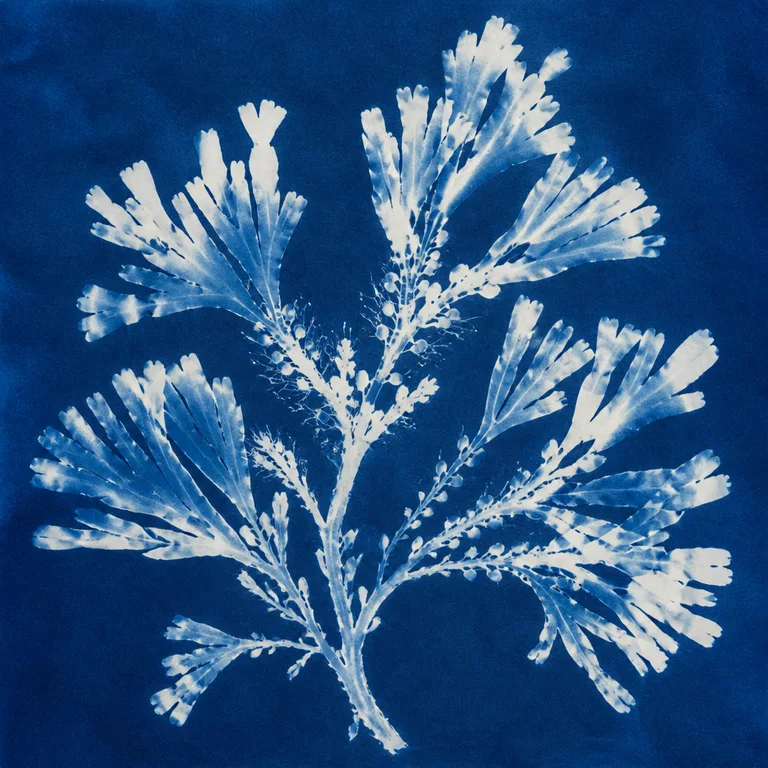
Description
A cyanotype is a 19th-century photographic printing process — paper coated with ferric ammonium citrate and potassium ferricyanide, exposed to UV light, washed in water. Produces the iconic Prussian-blue print. A photogram is what you make without a camera: objects laid directly on the sensitized paper, exposed, and developed. The combination — cyanotype photogram — is the technique Anna Atkins used in 1843 to publish Photographs of British Algae: Cyanotype Impressions, the first photographically illustrated book in history. As a visual style today, the cyanotype photogram is distinct from a "cyanotype photograph" (which uses a camera negative): no perspective, no depth of field, no focal plane. Just silhouetted shapes — leaves, fish bones, lace, hands, mechanical parts — in white and pale blue against a deep Prussian-blue ground. Edges are sharp where the object made contact, soft and feathered where it lifted off the paper. The blue is unique to the chemistry and impossible to replicate cleanly in digital filters. Use it for botanical art, scientific illustration with mood, fashion editorial, book covers, and any image that should feel handmade, archival, and contemplative. It does not do narrative scenes, color, or photoreal subjects. Specify "cyanotype photogram, objects laid directly on sensitized paper, no camera, silhouetted shapes in white and pale blue on Prussian-blue ground, sharp-edge contact lines and feathered lift-off edges, Anna Atkins reference."
Three pioneers
Every style in this catalog names three verifiable pioneers. This is the part of the drop test that takes the longest to write and is the easiest to spot when it's missing.
-
Anna Atkins
British botanist and photographer, 1799–1871. Photographs of British Algae: Cyanotype Impressions (1843), often cited as the first book illustrated with photographs and the first work by a female photographer of any kind. Made 307 cyanotype photograms of seaweed specimens.
-
Sir John Herschel
British scientist, 1792–1871. Invented the cyanotype process in 1842 — Atkins was a family friend and learned the method directly from him within a year of its publication.
-
László Moholy-Nagy
Hungarian artist, 1895–1946. His Bauhaus photogram experiments in the 1920s — though usually silver gelatin, not cyanotype — extended the photogram from scientific record to fine-art technique and re-introduced the no-camera approach to 20th-century art photography.
Contemporary revival
The persistent botanical-cyanotype craft revival (Etsy / Instagram), the New York Public Library's Anna Atkins online archive launch (2019), and contemporary fine-art use by Christian Marclay (cyanotype installations) and Hugo Deverchère
The NYPL's 2019 Anna Atkins digitization release drove a major design-press cycle and a documented uptick in 'cyanotype' search interest that has held a higher baseline since. #cyanotype on Instagram exceeds 1.4M posts. Etsy 'cyanotype kit' search returns over 5,000 listings — physical paper-and-chemical kits sold to home crafters. The Photographers' Gallery (London) and ICP (New York) have hosted multiple cyanotype-revival shows since 2020. Hugo Deverchère's cyanotype work is in the collection of the Centre Pompidou.
Working prompts
Three prompts we've tested against current FairStack models. Copy and run.
-
cyanotype photogram, Anna Atkins style, silhouetted seaweed specimen on Prussian-blue ground, white-and-pale-blue contact shapes, sharp edges where specimen touched paper, feathered soft edges where it lifted, hand-lettered Latin caption at bottom
-
contemporary cyanotype photogram of pressed wildflowers on heavy watercolor paper, no camera, deep Prussian-blue background, lace-like white botanical detail, slight paper texture visible
-
cyanotype photogram of small mechanical parts — keys, gears, watch components — arranged decoratively, archival book-plate quality, deep blue ground
Recommended models
Models from FairStack's catalog that handle this style best. Sorted by price.
Related styles
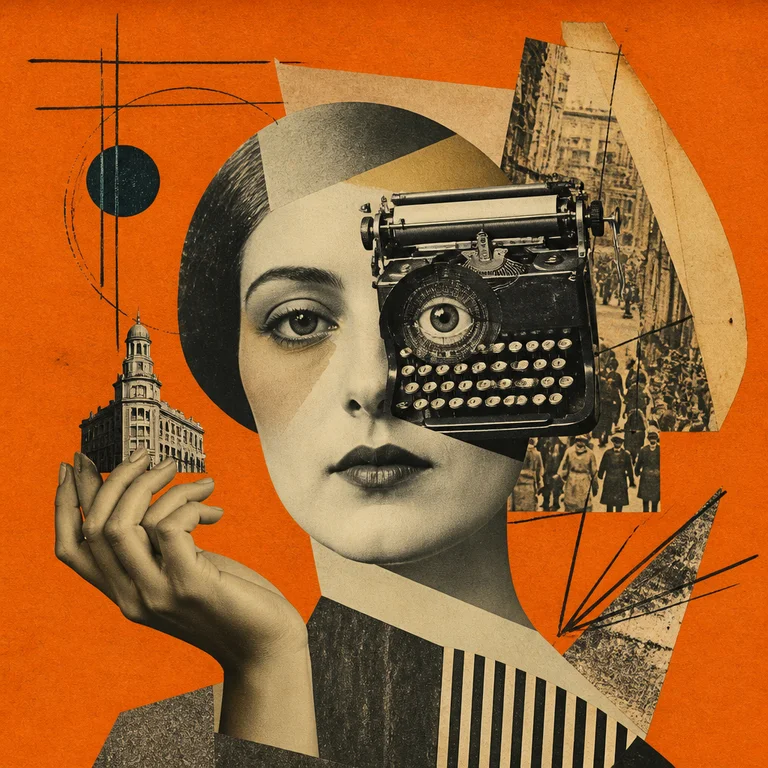
Photo-Collage (Hannah Höch Lineage)
Photographic collage as a fine-art form has a continuous lineage from Berlin Dada in the 1910s — where Hannah Höch coined what she called…
Open style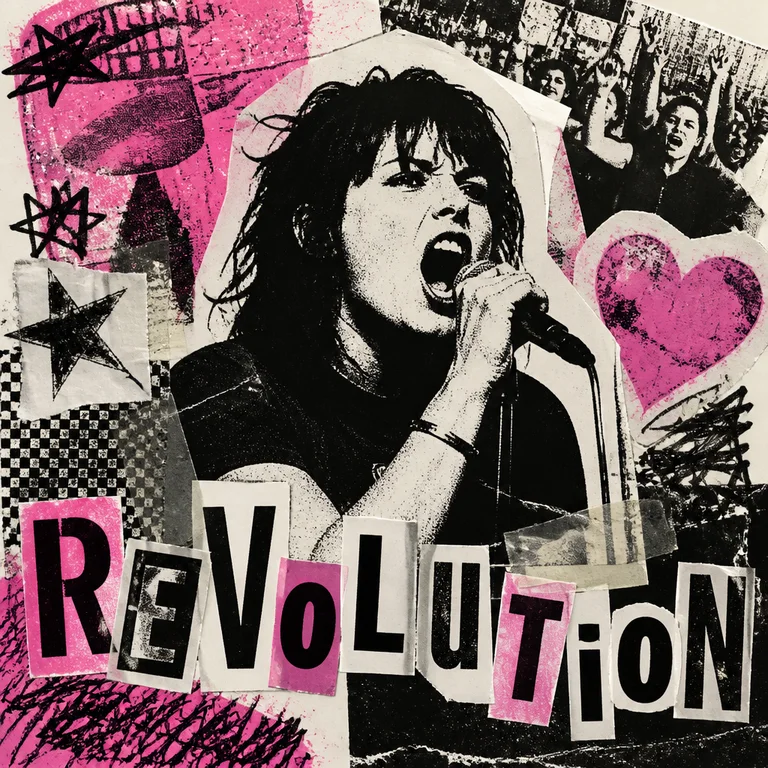
Lo-Fi Zine / Cut-and-Paste
The lo-fi zine aesthetic — photocopied, hand-assembled, deliberately rough printed matter — emerged from the late-1970s punk scene (Sniff…
Open style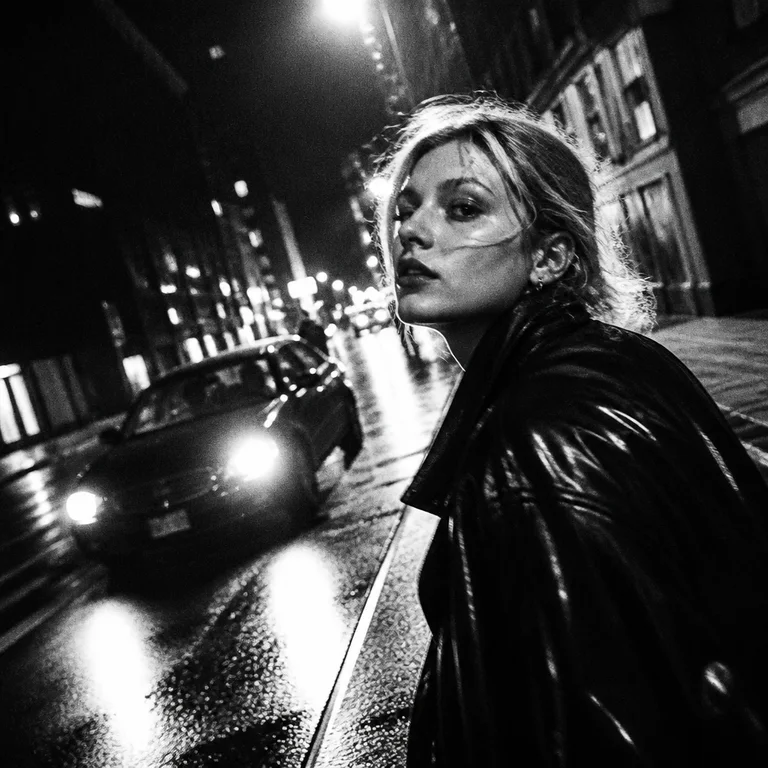
Daido Moriyama High-Contrast B&W
Daido Moriyama's photographs of postwar Tokyo are the most influential street photography to come out of Japan. The visual signature is e…
Open style
Linocut Relief Print
Linocut relief print is the look of an image cut into linoleum, inked, and pressed onto paper — a reductive medium where everything you s…
Open style